Search "homes for sale Bearden Knoxville" and the results will not agree with each other. A two-bedroom condo conversion at $225,000 sits a few rows above a $1.995 million stone estate, both filed under the same neighborhood name. If you're trying to use that median price to decide whether Bearden fits your budget, the number is telling you almost nothing about what you'd actually pay.
Now put Bearden next to its neighbor. Bearden and West Hills sit back to back off Kingston Pike in West Knoxville. They feed the same high school zone, Bearden High. Most sites that cover Knoxville real estate, ours included, group them together as a single area. You'd expect their prices to move in step.
They don't. Over the past 12 months, homes in Bearden sold for a median of $407,450, up 15 percent from the year before. Homes in West Hills, the neighborhood most locals think of as an extension of Bearden, sold for a median of $499,900, up a modest 1 percent over the same stretch. That's a gap of more than $90,000 between two places that share a school district, a commercial corridor, and, for most practical purposes, an address.
The usual explanations don't hold up. West Hills isn't closer to downtown Knoxville than Bearden is; it sits roughly 7 miles out compared to Bearden's 5. It isn't zoned to a stronger school. It isn't newer housing stock built decades apart. Both neighborhoods trace back to the same postwar building boom along Kingston Pike.
What actually explains the gap isn't where these two places sit. It's what's for sale inside each of them.
The West Hills story is a story about sameness
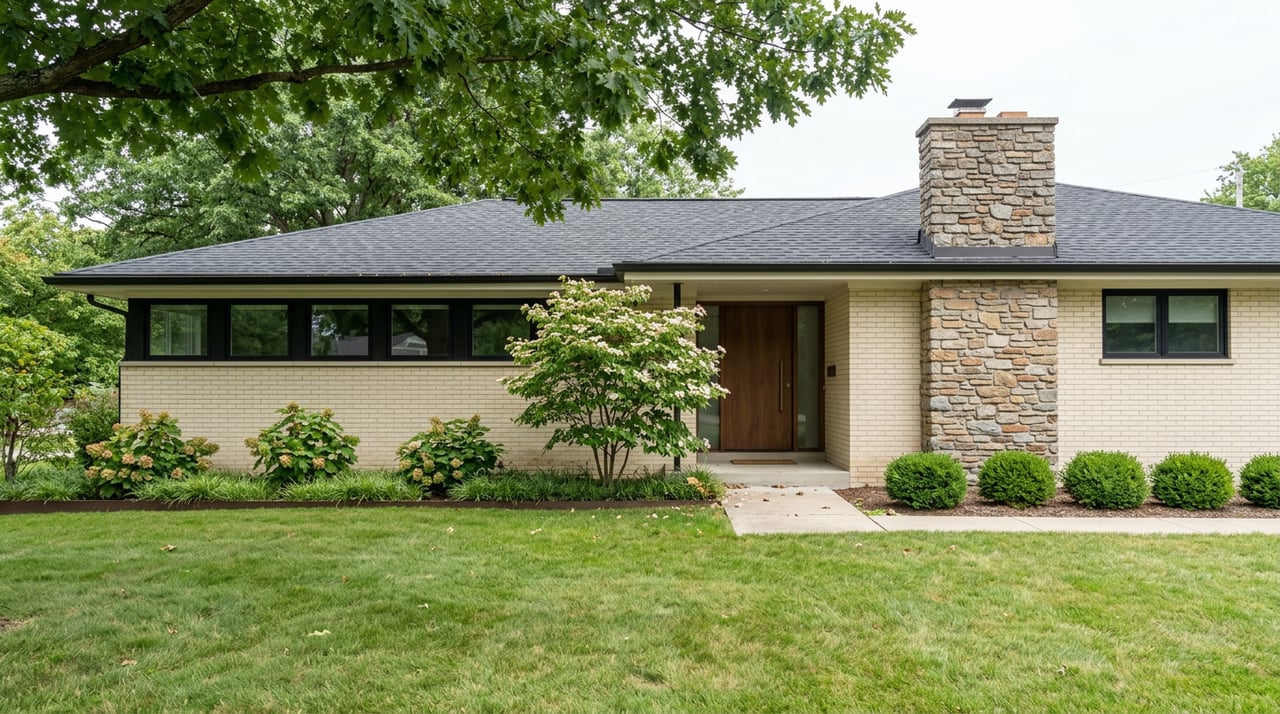
West Hills exists because a single developer, Morgan Schubert, bought up four family farms along Kingston Pike in the early 1950s and built Knoxville's first major postwar subdivision on the land. That's not a footnote. It's the reason the neighborhood looks the way it does 70 years later: block after block of brick ranch homes, built to a consistent scale, on lots generous enough to feel private without feeling remote.
What kept it that way is the second half of the story. When shopping centers started spreading through West Knoxville in the late 1950s and 1960s, West Hills residents organized to keep the commercial creep out of their subdivision. That effort became the West Hills Estates Civic Association, and in 1972 the group worked with Knoxville's Metropolitan Planning Commission to draft the West Hills Plan, a development framework the city later used as a model for other neighborhoods. The short version: West Hills has spent more than 50 years actively defending a single housing type against everything that might dilute it.
That defense shows up in today's listings. Right now, West Hills has six houses on the market, ranging from $279,900 to $1,225,000, and the middle of that range is dominated by the same kind of home over and over: a brick ranch on a quarter- to full-acre lot, some original, some renovated down to the studs. There's very little variety pulling the median up or down, because there isn't much variety on the market at all. When every option a buyer sees is a version of the same product, the price stops reflecting a wide market and starts reflecting a narrow one, and narrow markets with steady demand tend to hold their number.
Bearden sells the opposite thing
Bearden runs along the same stretch of Kingston Pike, but it never got a single civic association enforcing a single housing type. What's for sale there right now spans $225,000 to $1,995,000, a range nearly four times as wide as West Hills'. At the low end you'll find condo conversions and older attached units. In the middle sit the same midcentury ranches and split-levels you'd find in West Hills. At the top are grand stone and brick mansions, and increasingly, newly built duplexes replacing single older lots.
All of that trades under one neighborhood name, which means Bearden's median isn't describing a typical house the way West Hills' median is. It's finding the midpoint of a distribution that runs from a starter condo to a two-million-dollar estate. That's also why Bearden's ceiling is actually higher than West Hills' current top listing, even while its median sale price lands nearly $90,000 below it. A wide range of cheap and mid-priced inventory pulls a median down even when the top of the market is stronger.
The list price you see isn't the price that clears
There's a second layer worth knowing if you're actually shopping in West Hills this fall rather than comparing neighborhoods from a distance. As of July 2026, homes there were listed to buy at a median asking price of $624,000, a good 25 percent above the $499,900 median that actually closed over the trailing 12 months. That gap between what sellers are asking now and what buyers have actually been paying is itself worth reading. It suggests sellers have caught on to West Hills' scarcity story and are testing whether buyers will pay a premium for the predictability the neighborhood offers, ahead of the closed-sale data catching up to confirm it. If you're writing an offer in West Hills right now, anchor your number to what's closed, not to the asking price sitting at the top of your search results.
What this actually means for your search
If you want to walk into a home search already knowing that every option in front of you is roughly the same kind of house on a similar lot, West Hills does that sorting for you before you ever book a showing. The tradeoff is distance: you're a short drive, not a walk, from West Town Mall, Trader Joe's, Whole Foods, and the restaurant row that includes Big Kahuna Wings, Copper Cellar West, and Abridged Beer Company. West Hills' own John Bynon Park adds nearly two miles of trails if you want green space close to home. You're paying part of that West Hills number for not having to sort the market yourself.
If you'd rather have range, and you're willing to do more of the sorting, Bearden is where that range lives. You can walk to Lakeshore Park's nearly 200 acres along the Tennessee River, or into the same Kingston Pike corridor from the Bearden side, and choose between a condo, a midcentury ranch, or a new-build duplex within the same few blocks. The cost of that flexibility is that the "Bearden median" won't tell you much about your own price point. You have to price the specific type of home you want, not the neighborhood average.
Neither number is wrong. They're just measuring two different kinds of markets that happen to share a road.
A couple of things worth clearing up
Is West Hills technically part of Bearden? Not by the boundaries most local sources use. West Hills sits northwest of Bearden, generally bounded by Papermill Road to the south, Weisgarber Road to the east, and Walker Springs Road to the west. The two are often lumped together in casual conversation and in listing categories because they share Kingston Pike and a school zone, but they're distinct subdivisions with different histories.
Why does Bearden have such a wide price range in the first place? Because it never developed as a single planned subdivision the way West Hills did. It grew as a commercial and residential corridor over decades, which means older apartment-style condos, midcentury houses, and new construction all ended up coexisting under one neighborhood name instead of one consistent housing type.
If you're trying to figure out which of these two markets actually fits what you want, the median price on a portal search won't get you there. That's a conversation worth having with someone who can walk you through what's actually on the market right now, house by house, not neighborhood by neighborhood. Robyn Ray has spent years reading exactly these kinds of gaps across Knoxville's West Side. Let's Connect.